A brief history of the North End

The North End area of Fallout 4 contains several marked and unmarked locations, including: 

Madden's boxing gym on Salem Street in Fallout 4, near the Old North Church.
Screen capture by Jewelsmith

An actual photo of the corner of Salem and Prince Streets in Boston's North End neighborhood, with a green building similar to Madden's boxing gym in Fallout 4, and an Italian bakery. (Image from Google maps street view)

The Massachusett people inhabited the area until Europeans arrived, then they were decimated by disease (I've read estimates of 75-90% population loss) and further displaced by religious conversion and racism. 

English colonists settled there in the 1600s, and by the mid-1700s, just before the American Revolution, the North End was a hub of activity. 

But the North End changed after the Revolutionary War. Around 25% of the population (presumably Loyalists) moved to England or Canada, and wealthy merchants moved to the West End or Beacon Hill. Many homes (including Paul Revere's housebecame warehouses and sailor boarding houses

The land itself changed during the 1800s. The North End and other areas of Boston expanded through land reclamation projects, as shown in the diagram below. 

Map of the peninsula from Fallout 4 (left), with a green icon to indicate Swan's Pond in the Boston Common area, and a 1903 diagram (right) showing Boston Common and the actual shape of the original Shawmut Peninsula in black, with reclaimed land in gray. 
Fallout 4 map courtesy of Fallout4map.com 
Diagram from "Boston: A Guide Book" (public domain)

The Irish had been in Boston since the American Revolution. Patrick Carr of Ireland was shot by British soldiers during the Boston Massacre of 1770, and General George Washington even used the password "Saint Patrick" as a secret code with his Colonial troops. 

When tens of thousands of Irish immigrants arrived during and after the years of the Irish potato famine in the 1840s and 1850s, many settling in the North End. Disease was rampant in the impoverished and overcrowded neighborhood. A cholera epidemic hit the North End hard in 1849. 

“Children in the Irish district,” wrote Bostonian Lemuel Shattuck, “seemed literally born to die.” 

An area known as the "Black Sea" along Ann Street (now North Street) was estimated to have 227 brothels, 26 gambling dens and 1,500 establishments that sold liquor. It was described as "squealing with fiddles" and populated with criminals. 

In the 1870s, Jewish and Italian immigrants arrived. Salem Street and the blocks around it became a busy shopping district filled with Kosher butchers, bakers, delicatessens, tailors and food markets. 

A pizza place in the post-apocalyptic North End of Fallout 4 
(Screen capture by Jewelsmith)

Inside the Fallout 4 pizza place are an espresso machine and two fireplaces set up to look like pizza ovens (Screen capture by Jewelsmith)

Just like now, immigrants had to deal with a lot of discrimination, like this jerk Samuel Adams Drake who wrote about the North End in 1871: 

“Nowhere in Boston has Father Time wrought such ruthless changes, as in this highly respectable quarter, now swarming with Italians in every dirty nook and corner. In truth, it is hard to believe the evidence of our own senses, though the fumes of garlic are sufficiently convincing.” 

By 1895, the North End was 1/3 Irish, 1/3 Jewish and 1/3 Italian. But by the 1920s it was mostly Italian, and in the 1930s there were 44,000 Italians living in an area less than one square mile in size. 

The North End was also the location of the 1919 Great Molasses Flood, aka the Boston Molasses Disaster or Boston Molassacre. A large storage tank burst at the Purity Distilling Company and the resulting wave of molasses killed twenty-one people and injured one hundred and fifty more. 

In the aftermath, residents filed one of the first class-action lawsuits in Massachusetts. 

The disaster occurred on Commercial Street, and the area is now a park near Copps Hill Burying Ground, the burial place of Shem Drowne. 

Yes, Shem Drowne is a real person, not just a character in Fallout 4In the game, Shem Drowne is buried in North End Graveyard, across the street from Mean Pastries. 

Additional sources: 

The Freedom Trail: Bunker Hill

Fallout 4 Bunker Hill monument (left) and the IRL Bunker Hill monument (right)
PS4 screen capture by Jewelsmith - Photograph by Chensiyuan CC BY-SA 4.0 

In Fallout 4, the Freedom Trail seems to end at the Old North Church, with the conclusion of the Road to Freedom quest. 

However, there are bits of red line that can still be seen in the video game, going from the church to North End Graveyard and on to Bunker Hill. 

Because in real life, the Freedom Trail ends at Bunker Hill Monument. 

In Fallout 4, the red brick line of the Freedom Trail can be seen leading to the Bunker Hill Monument. In Boston, the North Washington Street Bridge connects Charlestown with the North End, just like this bridge that spans the Charles River in Fallout 4
PS4 screen capture by Jewelsmith

New England soldiers faced British forces in the Battle of Bunker Hill, on June 17, 1775. It is considered the first major battle of the American Revolution. 

Two months after the Battles of Lexington and Concord in April 1775 (and Paul Revere's Midnight Ride), colonial troops assembled to face off against the British soldiers stationed in Boston under General Thomas Gage (possibly where the raider character "Gage" gets his name in the game's Nuka-World expansion?). 

According to Britannica, more than 15,000 colonial troops from Massachusetts, Connecticut, New Hampshire and Rhode Island, and 5,000 British troops, assembled around Boston. However, Battlefields.org puts the number of troops who actually engaged in the Battle of Bunker Hill at 2,400 colonists and 3,000 British soldiers. 

During the battle, the British set fire to Charlestown. Spectators watched from hills, rooftops and steeples in Boston, and among them were Abigail Adams and her son, John Quincy, who was about 8 years old at the time but would go on to become the sixth president of the United States. 

Google map of the Charlestown and North End neighborhoods of IRL Boston, next to a map of the same areas in the video game Fallout 4 (courtesy of Fallout4map.com), showing Bunker Hill, USS Constitution, Copps Hill/North End Graveyard, Old North Church, and the North Washington Street Bridge

Charlestown is the area around Bunker Hill in Fallout 4, as well, where players also find the USS Constitution, BADTFL Regional Office, Charlestown laundry, Charlestown Condo creation club player home, abandoned house, and a piece of perfectly preserved pie.

The Battle of Bunker Hill was considered a victory for the British but at great cost. They sustained twice as many casualties as the colonists and lost many officers. About 450 colonial troops were killed, wounded or captured, and over 1,000 British troops were killed or wounded. 

The Bunker Hill Monument was completed in 1842 to memorialize the event. The stones of the monument came from quarries at Quincy. Players of Fallout 4 will know Quincy as the place overrun by Gunners, and the nearby Quincy Quarries as the site of Vault 88, but there's a Quincy and quarries in real life, too. 


William Prescott statue and Bunker Hill monument, Boston, Massachusetts
Photo by Tom Klein 2016, courtesy of The Cultural Landscape Foundation

Minuteman statue in front of Bunker Hill monument in Fallout 4
Screen capture by Jewelsmith

In the game, Bunker Hill is a post-apocalyptic settlement built around the monument and its adjacent lodge, the partially-ruined building where players meet Old Man Stockton, Deb and the caravan merchants. 

During the quest titled "The Battle of Bunker Hill," the lodge is also where players find escaped synths amidst a battle between the Railroad, Institute and Brotherhood of Steel factions. 

Check out my other articles and return for updates or follow me on YouTube, Twitter or Patreon for more information.

~ Jewelsmith (aka JLHilton)

Additional sources: 


The Freedom Trail: USS Constitution

The real-life USS Constitution in Boston Harbor - Photo courtesy of the National Park Service

USS Constitution, as seen in Fallout 4 - Screen shot by Peace'n Hugs from the Fallout wiki

USS Constitution is the oldest commissioned ship in the United States Navy. Built at Edmund Hartt's shipyard in the North End of Boston, it launched more than 220 years ago on October 21, 1797. 

Sixty acres of trees were used in its construction. Bolts that fastened the timbers and copper sheathing were made by Paul Revere (whose house is also on the Freedom Trail and whose bronze statue sits outside Old North Church)

With a 204-foot overall length, Constitution was rated a 44-gun frigate but often carried more than fifty guns, along with a crew of around 450. 
It earned the nickname "Old Ironsides" during the War of 1812 because the cannon fire from enemy ships could not penetrate the strong oak hull. 

In Fallout 4, a rocket-powered USS Constitution is found atop Weatherby Savings & Loan, with a robotic crew led by a sentry bot named Captain Ironsides. 

During the side quest "Last Voyage of the U.S.S. Constitution," players have the option of assisting Captain Ironsides by repairing the ship and earning a unique weapon called Broadsider, which is a modified naval cannon with explosive cannonballs. 

Captain Ironsides (right) aboard USS Constitution in Fallout 4 
PS4 screen shot by Jewelsmith

"Old Ironsides" is also the name of a poem written by Oliver Wendell Holmes Sr in 1830, as a tribute to the real Constitution. His poem roused public sentiment and saved the ship from being decommissioned. 

Today, officers and crew from the US Navy still serve aboard Constitution, which is located in the Charlestown Navy Yard and part of Boston National Historic Park. 

After some renovations, Constitution sailed in July 1997 to celebrate its bicentennial, and again in August 2012 to mark the 200th anniversary of its victories in the War of 1812. But mainly the ship serves as a historic site, open to the public free of charge.  

Check out my other articles and return for updates or follow me on YouTubeTwitter or Patreon for more information.

Jewelsmith (aka JLHilton)

Sources for this article and sites for further reading: 


Salem: Museum of Witchcraft

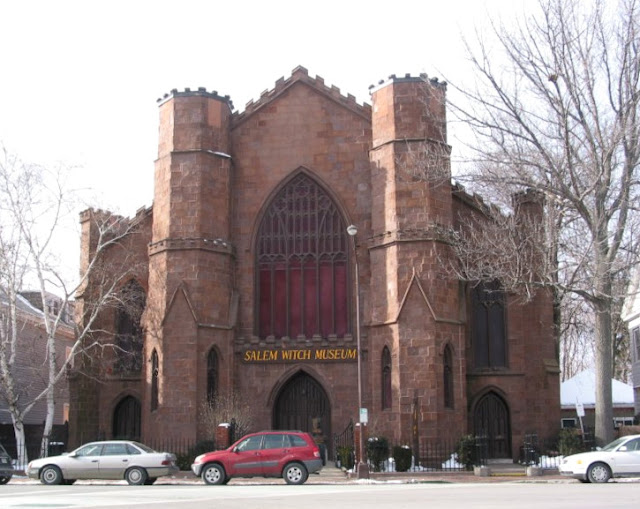
The Museum of Witchcraft in Fallout 4 appears to be based on the Salem Witch Museum and possibly other attractions in the town of Salem such as the Witch Dungeon Museum and Salem Wax Museum.

The Salem Witch Museum in Salem, Massachusetts
Photo courtesy of Wikipedia CC BY-SA 3.0

The Museum of Witchcraft location in the video game Fallout 4 looks almost exactly like the IRL Salem Witch Museum 
PS4 screen capture by Jewelsmith

I couldn't find pictures of the Salem Witch Museum's exhibits but several reviews on TripAdvisor.com describe mannequins and "dusty dioramas" that sound similar to the game's portrayal of the museum. 

One of the dioramas inside the Museum of Witchcraft in Fallout 4
PS4 screen capture by Jewelsmith

Salem, Massachusetts, is well known for its witch trials, which inspired such movies as Bell Book and Candle (1958), Hocus Pocus (1993), The Crucible (1996) and ParaNorman (2012), and are mentioned in several TV shows throughout the past several decades, including Bewitched, The Simpsons, Charmed, Ghost Hunters, The Vampire Diaries and WandaVision

Computer terminal showing "Today's Attractions" in the Fallout 4 Museum of Witchcraft, including a "witchcraft walk," relic collection and gift shop. 
PS4 screen capture by Jewelsmith

A brief history of the Salem witch trials

In January 1692, three girls, ages 9-11, started having strange fits, making odd noises and throwing things. A local doctor blamed the supernatural. Magistrates pressured the girls into blaming a slave named Tituba, a homeless beggar named Sarah Good, and a poor elderly woman named Sarah Osborne. 

As the affliction spread to other children, many more members of the community were questioned. Despite declaring her innocence, Bridget Bishop, a local woman with a reputation for being a promiscuous gossip, became the first person hanged for practicing witchcraft in Salem, in June 1692. Her own husband even testified against her, claiming that she praised the devil. 

Within the next few months, eighteen more executions followed. A man was also pressed to death with heavy stones and four people died in jail, including a baby girl born before her mother was hanged. 

A life-sized diorama of mannequins, found within the Fallout 4 Museum of Witchcraft, depicts a woman burned at the stake while others watch 
PS4 screen capture by Jewelsmith

One of the museum's exhibits in Fallout 4 depicts a woman being burned at the stake, but no one was burned for the crime of witchcraft in America. In 17th century England and its colonies, witchcraft was punished by hanging. 

On October 3, 1692, Increase Mather, then president of Harvard, spoke out against the trials and said, "It were better that ten suspected witches should escape than one innocent person be condemned." 

But arrests and trials continued into 1693. When his wife Mary Phips was accused of witchcraft, Massachusetts Governor William Phips prohibited further arrests, pardoned the guilty and released those who were imprisoned. 

The Salem witch hunt hysteria died down and there were legal attempts to seek restitution and exoneration for those who were found guilty. Over the years, monuments were erected to the victims. 

On October 31, 2001, more than 300 years after the trials, Massachusetts Governor Jane Swift signed a proclamation that decreed every one of the accused to be innocent. 

Maps showing the location of the Salem Witch Museum in Massachusetts (left) and the Museum of Witchcraft in the post-apocalyptic wasteland of Fallout 4 

So, why did it even happen in the first place? 

A guide to hunting witches called "Malleus Maleficarum" was published in the 1480s and it was so popular, no other book sold more copies at the time except the Bible. Think of it as one of the first viral misinformation campaigns. Within 200 years of its first printing, an estimated 80,000 suspected witches were executed in Europe. Around 80% of those were women. 

Thanks a lot, Gutenberg.
While witch hunts were dying out in Europe by the late 17th century, many folks were still primed to believe in the devil and supernatural powers. Governor Phips himself supposedly dabbled in astrology and believed in the existence of witchcraft, he just didn't believe that those accused in Salem were guilty of it. People in Salem even attempted to use a kind of magic in the form of "witch cakesto identify witchcraft. 

Some historians have suggested that ergot poisoning was to blame for the hysteria in Salem or that the slave Tituba worked people up with tales of voodoo from her homeland. 

But spite, jealousy, greed and other psychological factors were probably the prime motivations of those who carried out the accusations, arrests and executions. As with European witch trials, the accused in Salem were often women who went against societal conventions or religious morals in some way - such as Bridget Bishop's alleged promiscuity or Sarah Good's homelessness. Or they were people in possession of property that was immediately confiscated and sold - such as innkeeper and landowner John Proctor and his wife Elizabeth. 

Other points of interest near the museum

Just across the street from the Museum of Witchcraft in Fallout 4, in a pile of rubble, players can see a fallen street sign that says "Oakland St". 

A fallen street sign near the Museum of Witchcraft says "Oakland St" in Fallout 4 
Screen capture by Jewelsmith

This is strange because the Salem Witch Museum sits between Washington Square, Kimball Court, and Brown and Williams Streets in the real world. 

The location of the Salem Witch Museum, courtesy of Google Maps

There is an Oakland Street in Salem, but based on Google street view it appears to be a residential area over a mile from the museum. 

So many other streets and locations in the game are named according to their IRL counterparts, why is this one different? My best guess is that one of the game's developers has some connection to Oakland Street, perhaps growing up there, and the street sign is some kind of personal reference. But that is just a theory and not confirmed in any way. 

A hollowed-out rock containing a note behind the Museum of Witchcraft in Fallout 4 
PS4 screen capture by Jewelsmith

In the video game, there are a couple of gravestones behind the Museum of Witchcraft, along with a hollowed-out rock that contains a note, fifty bottlecaps, some ammo, four baseball grenades, bubblegum, a rifle, three RadAway and three Stimpaks. 

There is a second hollowed-out rock containing the same stash, along with the exact same note, on the east side of the museum, too. 

The note in the hollowed-out rock is addressed to "S," signed "E," and mentions Megaton, a major town in the Capital Wasteland in Fallout 3. 
PS4 screen capture by Jewelsmith

“S” and “E” might be Sticky and Eclair, who were children living in Little Lamplight along with MacCready during Fallout 3. Perhaps, like MacCready, they eventually made their way to the Commonwealth? The presence of baseballs (rather than the more typical frag grenades) and bubblegum might be hints that confirm this theory, as they are childish things. 

Or the reference to Hell (with a capital H) might be a clue pointing to Underworld, another major settlement in Fallout 3. If so, the "S" might be Sydney, a relic hunter who sells guns there (depending on how you finish one of the quests) and the "E" would be her mercenary friend Emaline. 

The note mentions Megaton, which is a major settlement in the 2008 video game Fallout 3. For many players, it's one of the first locations visited and offers several quests, merchants, and a permanent home for the vault dweller. 

But, guess what? There’s also a hollowed-out rock behind Megaton. It contains ten .308 rounds, a sniper rifle, one stealth boy, two stimpaks and a note titled “As Requested,” which reads: “S, Here's that stuff you wanted. If anyone asks where you got it -- say it was a gift from your grandma. Happy hunting! E”  

The message from the hollowed-out rock behind Megaton in Fallout 3. 
PC screen capture by Jewelsmith

This message is probably not from Eclair to Sticky, since they're children living in Little Lamplight during Fallout 3, but it could still be a reference to Sydney and Emaline. 

Except that there's also a note, from "E" to "S" in Bloodmoon, the 2003 expansion for The Elder Scrolls III: Morrowind, hidden in a hollow tree stump with some trinkets and ebony arrows near Thirsk mead hall on Solstheim.

The message found in a hollow tree stump behind Thirsk mead hall in The Elder Scrolls III: Morrowind. Courtesy of Imperatia

The blood-stained note says: "S, Here is the equipment I told you about. Remember, the weak deserve no mercy. - E" 

So, "S" and "E" are probably not Sydney and Emaline. My guess is that these are personal messages from one of the developers. 

In any case, the stashes in Fallout 4 do respawn and are a great way to stock up on supplies. 

Jewelsmith (aka JLHilton)

Sources: 


The Freedom Trail: North End Graveyard & Shem Drowne

The North End Graveyard is an unmarked location in Fallout 4, across the street from Mean Pastries, west of Pickman's Gallery and east of Cabot House. Players may end up there during the Gilded Grasshopper quest, in which case they can dig up the grave of Shem Drowne for some loot. 

Shem Drowne was a real person, not just a video game story, and he really did make a gilded grasshopper weathervane (read more about that in my Faneuil Hall section). Though whether or not he's actually buried with a radioactive sword or with bars of copper, silver and gold, I have no idea. 

The real-life grave marker of Shem Drowne (right) and his wife Katherine, at Copp's Hill Burying Ground in Boston. 
Photo by Diane Blair via FindaGrave.com

Shem Drowne's grave and headstone in Fallout 4, after digging up his coffin during the Gilded Grasshopper quest. 
PS4 screen capture by Jewelsmith

With the cemetery's location relative to the Old North Church and other landmarks in Fallout 4, and the existence of Drowne's grave there, North End Graveyard seems to be based on Copp's Hill Burying Ground in Boston. 

Copp's Hill Burying Ground in Boston
Photo by Rhododendrites via Wikipedia CC BY-SA 4.0

North End graveyard as seen in Fallout 4, based on Copp's Hill Burying Ground in Boston 
PS4 screen capture by Jewelsmith

In use for about two hundred years, from 1659 until the mid-1800s, Copp's Hill is the final resting place of more than 10,000 people, including: 

  • Shem and Katherine Drowne
  • Cotton Mather and his father Increase Mather, two Puritans who were associated with the Salem witch trials 
  • Prince Hall, leader of the free black community of Boston in the 1700s 
  • Robert Newman, the guy who put the lanterns in the Old North Church steeple for Paul Revere 
  • Edmund Hartt, builder of the USS Constitution 

During the Revolutionary War, British troops used the hill to fire artillery onto Charlestown during the Battle of Bunker Hill and possibly used the gravestones for target practice. 

Copp's Hill Burying Ground, with Skinny House across the street, and Old North Church in Boston, courtesy of Google maps

Across the street from Copp's Hill Burying Ground in modern-day Boston is an unusual building called Skinny House, while across the street from North End Graveyard in Fallout 4 is an unmarked bakery called Mean Pastries. 

I didn't think there was any connection between the two locations until I read that Skinny House is a "spite house" built to anger its neighbors. 

Maybe that's why the pastry shop in Fallout 4 is "mean" - because it's spiteful? 

The front of Mean Pastries bakery in Fallout 4, across the street from North End Graveyard, and with the green, white and red bunting seen throughout the North End area of the game. Inset map shows the location of the bakery (indicated by the arrow) as well as Pickman Gallery, the Old North Church and Railroad HQ. 
PS4 screen capture by Jewelsmith, map from Fallout4map.com

While Copp's Hill Burying Ground is a stop on the Freedom Trail in Boston, in Fallout 4 the "Road to Freedom" quest ends at Old North Church.

However, there are still pieces of the red brick line that can be followed to North End Graveyard and Bunker Hill in the video game, without seals to mark them as official sites because they're not needed to decode the password for Railroad HQ. 

A red brick line can be seen by North End graveyard, but there's no seal to mark it as a stop on the Freedom Trail in Fallout 4 - PS4 screen capture by Jewelsmith

Check out my other articles and return for updates or follow me on YouTube, Twitter or Patreon for more information.

~ Jewelsmith (aka JLHilton)

Sources:

TheFreedomTrail.org

Boston.gov 

Wikipedia 

Ghosts & Gravestones of Boston 

Waterfront: Custom House Tower

The Custom House was built on the waterfront between 1837 and 1847. It contained offices for the collectors, inspectors, clerks and other officials who enforced laws, collected taxes and oversaw the import and export of goods in Boston Harbor. 

The Custom House Tower as seen in Fallout 4 (left) and IRL (right)
Screen capture by Jewelsmith, photo from Google maps street view

In both Boston and the video game Fallout 4, the Custom House Tower is not on the Freedom Trail but is close to the Old State House (Goodneighbor in the game), Fanueil Hall and Paul Revere's house

The Old State House can be seen when standing outside of the Custom House and looking up State Street. It's the little red brick building with a white steeple. 
Image from Google maps street view

Before further land reclamation in the mid-19th century, the Custom House sat right on the edge of the water, so that ships moored at Long Wharf almost touched the eastern face of the building. 

Now, nearly two centuries later, it is several blocks away from the waterfront.

A satellite view of the Custom House Tower and Long Wharf in Boston 
Courtesy of Google maps

In Fallout 4, the Custom House Tower (icon bottom left) is south of Columbus Park, Paul Revere's House, Railroad HQ and Old North Church, and west of Long Wharf (the arrow on the Pipboy map). Screen capture by Jewelsmith 

The building was designed by Ammi B. Young, who went on to become the first Supervising Architect of the U.S. Treasury Department in 1852. In that capacity, he was responsible for the design of custom houses, post offices and other buildings across the nation, from Burlington, Vermont, to San Francisco, California.

The original Custom House building as designed by Ammi B. Young, before the architectural firm of Peabody & Stearns added a tower in 1913-1915. 
Public domain image from a 1905 post card

The thirty-two columns of the Custom House were carved from Quincy granite. Each column measured over five feet in diameter, stood thirty-two feet high, and weighed forty-two tons. 

(Yes, the Quincy Quarries in Fallout 4 are inspired by real life, too. Quincy granite was used throughout Boston, in such places as the Bunker Hill Monument, the Franklin obelisk in the Old Granary Burying Ground, and the base of the statue outside Faneuil Hall.) 


The exterior of the Custom House building as it appears in Fallout 4
Screen capture by Jewelsmith

The exterior of the original Custom House building IRL. 
Image from Google street view

The tower was built in 1915 for additional office space. At that time, commercial buildings were limited to 125 feet tall, but the federal Custom House was exempt from those restrictions. 

So, at a height of 496 feet (151 meters), it became the tallest building in the city until the Prudential Tower in 1964. 


As part of the Custom House District, it was added to the National Register of Historic Places in 1973. 

U.S. Customs officials moved out in 1986. The city of Boston bought the building but it was unoccupied and inaccessible for fourteen years. It currently operates as a Marriott hotel

In Fallout 4, the Custom House Tower is not accessible either, except for one small, bottom floor room, filled with Halloween decorations, bloody skeletons, super mutant gore and a couple of statues. 

This is the only room inside the Custom House in Fallout 4. It's filled with Halloween decorations, bloody skeletons and super mutant gore. 
Screen capture by Jewelsmith

I'll be writing more about Fallout 4 locations and their real-world inspirations in the months to come. Check back for updates or follow me on YouTubeTwitter and Patreon for more information.


Addtional sources: 


Custom House Tower (Wikipedia)